
AI SDR — AI Sales Development Representative
Your AI SDR works alongside your sales team — giving every single lead a genuinely personal response, at a scale no human team could match. Not just the obvious enterprise deal. Not just the high-intent hand-raiser. Every lead gets outreach built from who they are, what they explored, and what their company looks like. Your reps review and approve. The AI handles the volume.
What it looks like in practice
The enterprise evaluator buried in your free trial volume
It's Monday morning. Your PLG product had 340 signups last week. Buried in that volume: Marcus, VP of Engineering at a 200-person fintech. He didn't just sign up — he spent 40 minutes exploring your API documentation, visited your enterprise pricing page twice, and came back the next day to check your security docs.
Your SDR queue shows 340 new leads, sorted by signup date. Marcus is on page 3.
Within minutes of Marcus signing up, the agent has already built his complete picture. It pulls his pre-signup browsing history — the API docs session, the enterprise pricing visits, the security page, in what order, time spent on each. It enriches his profile from Apollo: VP Engineering, Meridian Fintech, 200 employees. Then it goes further — it pulls Meridian's full company profile and scans their team: 12 engineers, a Head of DevOps, a CTO, a VP Product. It estimates potential seat count, maps the likely buying committee, and calculates probable MRR range.
Marcus signed up as one person. The agent immediately understands he represents a potential 15-seat enterprise deal.
It scores him as high-intent, high-fit, drafts outreach that references what he actually explored — not a generic welcome sequence — and sends your rep a Slack notification within minutes of signup:
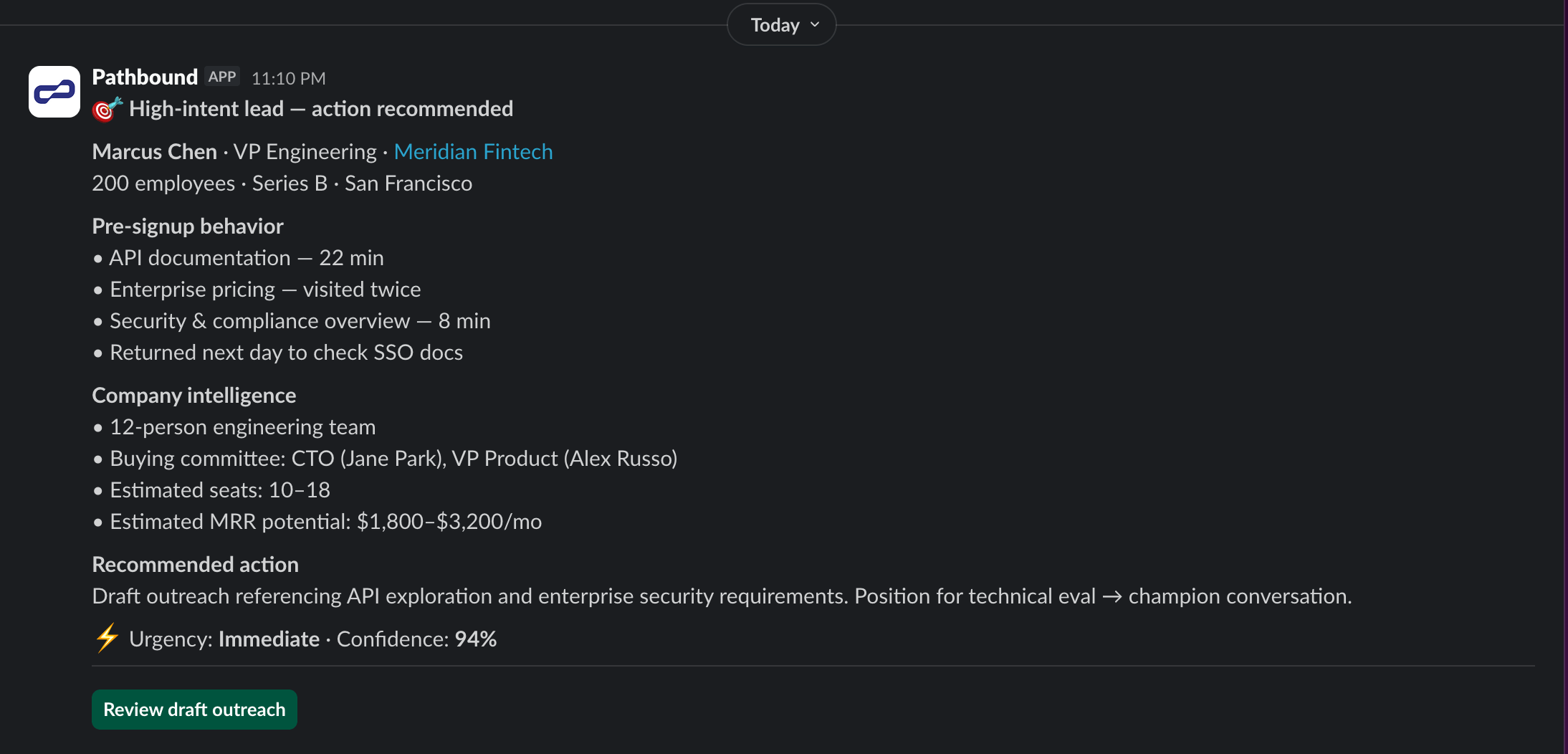
The rep reads the draft, edits one line, approves. Marcus hears from a human who clearly understands what he was looking for — within minutes of signing up, before he's even finished his first session.
The inbound lead who filled out your form at 11pm
Sarah, Head of Revenue Ops at a 90-person SaaS company, fills out your contact form on a Wednesday night. She's been on your site three times this week — first from a Google ad, then direct, then from a LinkedIn post. She read your comparison page, your HubSpot integration page, and spent 8 minutes on your pricing page before filling out the form.
Your CRM shows: new lead, source = web form. That's it.
The agent already knows Sarah's full journey before she submitted the form — all three sessions, every page, every return. When the form submission arrives, it enriches her record from Apollo: Head of Revenue Ops, 90-person SaaS company, tech stack confirmed. Then it maps her company — 8 people on the revenue/ops team, a VP Sales, a CTO, a Head of Finance. Potential buying committee identified. Likely 6–10 seats across the RevOps and sales org.
It correlates her pre-form browsing with everything it now knows and produces a complete pre-call brief: what she's likely evaluating Pathbound for, which features caught her attention, what objections she might raise based on the comparison page she read, and who else at her company might be looped into the decision. Your rep walks into the discovery call knowing Sarah has been actively evaluating for at least a week, is already comparing you to competitors, and that the deal could be larger than a single-seat RevOps purchase.
The "ordinary" signup who gets a personal response anyway
It's Tuesday. Your product had 47 signups yesterday. Most are students, indie hackers, people poking around. But among them: Tom, a mid-level ops manager at a 60-person logistics company. He signed up, spent 12 minutes exploring your onboarding automation feature, skimmed your pricing page once, and left. No enterprise signals. No pricing page obsession. No big company logo.
Under your current process, Tom gets the standard welcome drip. Same as everyone else. Because no human has time to research 47 signups a day and write 47 different emails.
Within minutes of Tom's signup, the agent builds his full picture. His behavior: 12 minutes on onboarding automation, skipped the API docs entirely, one quick look at the Growth plan. His company from Apollo: 60-person logistics firm, 8-person ops team, a Head of Ops and a COO above Tom. Not a massive deal — but a real one. 4–6 seats, a genuine use case, a team that would actually use the product.
The agent drafts an outreach that references what Tom actually looked at — onboarding automation for ops teams, not a generic pitch — and notes the relevant context for your rep: mid-tier opportunity, Tom is likely an internal champion rather than the budget holder, worth a soft touch rather than a full sales push.
Tom gets a message that feels like someone actually looked at his signup. Because something did. His reply rate is meaningfully higher than the drip sequence he would have gotten. And your rep spent 45 seconds approving the message, not 20 minutes researching him. That's what happens across all 47 signups. Every single one gets a response built for them — not a template with their first name in it.
The lead who went cold — and just came back
Three weeks ago, James from a Series B startup visited your site, started a trial, and disappeared after day two. Never activated. Got the standard drip sequence. No response.
Today he's back — visited your site directly, went straight to your pricing page, and spent 6 minutes reading about your enterprise plan.
The agent recognizes James from his previous session. It sees the full history — original trial, where he stalled, that he never activated the HubSpot integration, that he opened your emails but didn't click. It flags his return as a strong re-engagement signal and drafts an outreach that acknowledges the gap without being awkward: references what he explored this time, asks whether something changed on his end. Your rep gets the full picture in one Slack message. Not "James visited your site" — the whole story.
The dead lead whose company just got funded
Emma signed up for a trial four months ago. Your SDR marked her as "low fit" — small startup, no budget signal. She's been sitting in your CRM doing nothing.
Last week, her company announced a $12M Series A. This week, she's back on your site.
The agent monitors enrichment signals continuously. When Emma's company data updates — $12M Series A, headcount growing from 9 to 28 employees, 3 new engineering hires in the last month — it re-scores her automatically. Her fit score jumps from low to high. The agent maps the new company profile: a growing eng team, a newly hired VP Sales, budget that didn't exist 4 months ago. Estimated seat potential has tripled.
When she visits the site again, the agent treats her as a fresh high-priority lead and drafts outreach that reflects where she is now — referencing the company's growth stage, not the scrappy startup that couldn't afford it four months ago. Nothing slips through because someone marked a lead "low fit" at the wrong moment.
What the AI SDR sees that others don't
Most AI SDR tools see your CRM. Some see your email. A few see your website. Pathbound's AI SDR sees all of it — unified into a single profile per lead.

Website behavior
Every page, every session, time spent, return visits, scroll depth

Product usage
Trial activity, feature exploration, where they stalled

CRM history
All previous interactions, past deal stages, rep notes

Support conversations
Tickets opened, questions asked, frustrations expressed

Enrichment data
Company size, funding, tech stack, headcount changes, LinkedIn role

Email engagement
Opens, clicks, what they clicked on, sequence history
The signal that triggers outreach isn't just "visited pricing page." It's "visited pricing page twice this week, previously stalled on API setup, company just grew from 40 to 65 employees, opened your last two emails but didn't respond."
What it does
Gives every lead a personal response
Every signup, every form fill, every returning visitor gets outreach built from their actual behavior and company profile. Not a template. Not a drip sequence. Something that could only have been written for them.
Scores and prioritizes the queue
Behavioral signals combined with firmographic fit — not demographics alone. Your reps know who needs their attention first, and what level of push each lead warrants.
Maps the company, not just the person
Every lead gets enriched with their full company profile — team size, org structure, colleagues, tech stack, funding. One signup becomes a full account picture: potential seat count, likely buying committee, estimated MRR.
Routes to the right rep with full context
High-intent leads become CRM tasks with a complete brief. Mid-tier leads get a soft-touch draft. Low-fit visitors are filtered. Everyone gets handled appropriately.
Keeps your CRM current automatically
Behavioral data, enrichment updates, engagement history — synced without your reps doing data entry.
Resurfaces leads at the right moment
When a cold lead returns, when a company gets funded, when a trial user comes back — the agent notices and drafts the right message for where they are now.
Human-in-the-loop
Your team stays in control
Every outreach draft goes to Slack for review before it sends. Your reps read it, edit if needed, approve. You set autonomy levels per action type — suggest only, supervised, or fully autonomous for trusted workflows. The AI handles the volume and the research. Your reps handle the relationships.
Integrations
Connects everything where your data lives
No rip-and-replace. Pathbound connects to your existing stack — CRM, enrichment providers, product analytics, email, LinkedIn, support tools, billing, and any system with an API. Every data source becomes part of the same lead profile.
See all integrations →What changes
Every lead gets a personal response — not just the ones your reps have time to research
No enterprise evaluator gets buried in PLG signup volume
No mid-tier opportunity gets a generic drip because no one had time to look
Outreach references what the prospect actually did — not a template with their name swapped in
Your reps spend time on conversations, not lead research
Cold leads resurface automatically when the timing is right
One person signs up — the agent immediately understands the full account opportunity behind them
Frequently asked questions
What is an AI SDR?
An AI SDR (AI Sales Development Representative) is an AI agent that handles the data-intensive side of sales development — scoring leads, enriching records, drafting outreach, and routing qualified prospects — so your human reps can focus on conversations and closing.
The difference between an AI SDR and a simple automation tool is context. Basic automations trigger on a single signal ("filled out form → send email"). An AI SDR reasons about the full picture — behavioral history, firmographic fit, engagement patterns, previous interactions — and produces outreach that's relevant to where this specific prospect is right now.
Pathbound's AI SDR operates on unified customer data from every connected system, which means its context is genuinely complete. It doesn't just see what happened in your CRM. It sees your website, your product, your support tool, your enrichment data — all in a single profile.
Will AI replace sales development representatives?
No. And the reason is worth understanding clearly.
AI SDR tools excel at the work human SDRs find least valuable: processing hundreds of leads, researching company profiles, enriching CRM records, writing first-touch drafts, and triaging inbound volume at 2am. These are tasks that consume the majority of a human SDR's day — and produce the least relationship value.
What AI cannot replace is what makes a great SDR irreplaceable: reading a prospect's hesitation on a call, navigating a complex buying committee with competing priorities, building genuine rapport over multiple conversations, and knowing when to push and when to back off. These are human skills that close deals.
What changes: your SDRs stop spending 70% of their time on research and triage, and start spending it on conversations. Each rep handles more pipeline, with better context, and better personalization than they could ever produce manually. The AI does the volume work. Your reps do the human work. That combination outperforms either alone.
Deploy AI agents alongside your team
Start your 14-day free trial. Deploy AI agents that empower your team to handle customer operations at scale — with every action reviewable and approvable. No credit card required.